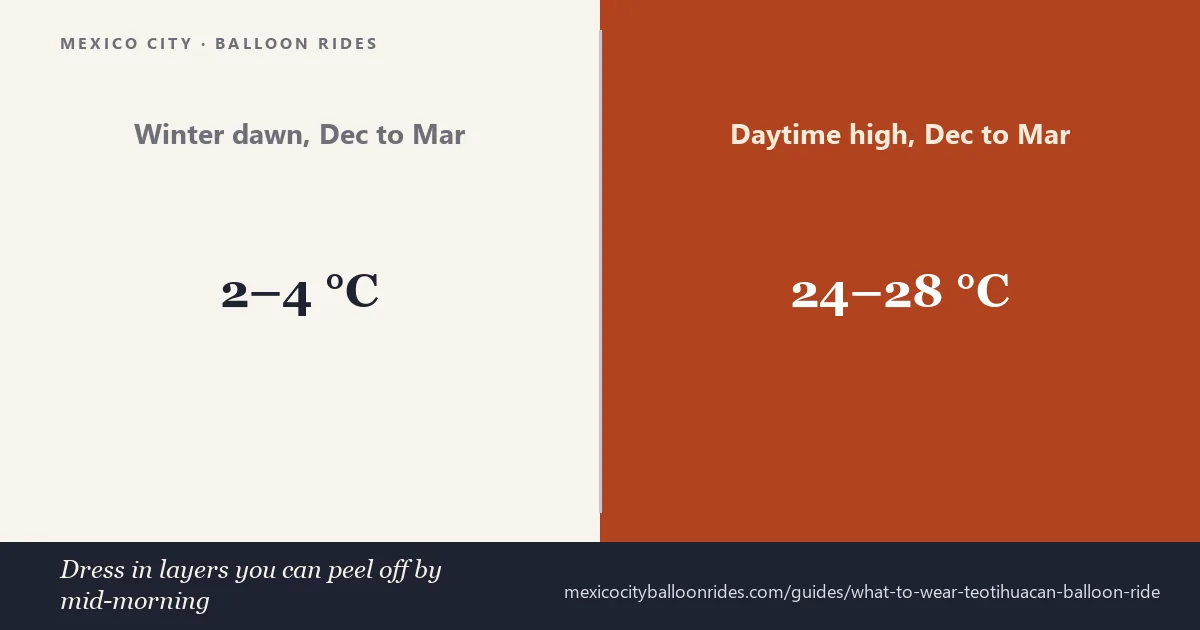
Dress in layers you can peel off: a warm jacket over a sweater or fleece, long trousers and closed, flat shoes. From December to March the average dawn low in the Teotihuacán valley is about 2 to 4 °C, yet the average daytime high at the same weather station is 24 °C or more, so the coat you need at 6 a.m. is dead weight by the time you walk the ruins. Add sunglasses, a snug cap, sunscreen and your passport or photo ID, and leave sandals, heels, skirts and big bags at the hotel.
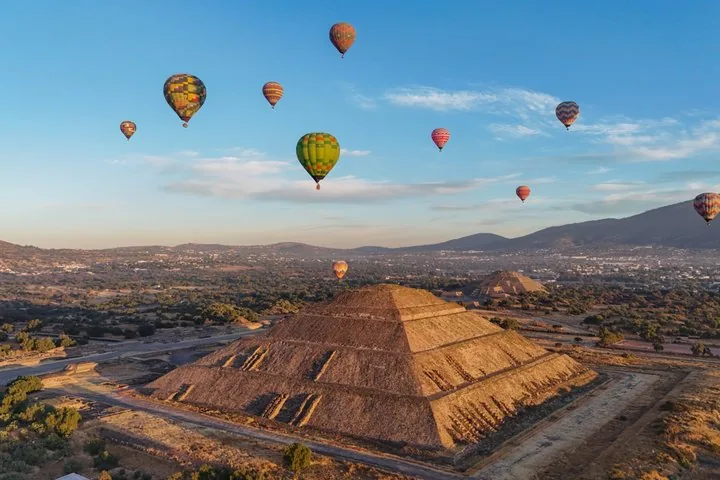
Balloon Flight with Breakfast in a Natural Cave and Transportation from CDMX
- 4.9/5 (1,528 reviews)
- 3–6 hours by option
- Free cancellation
- Operated by Skyteam Teotihuacán
Includes Hot air balloon flight · Flight certificate · Tasting of typical drinks
You'll choose your date and complete the booking on Viator. Free cancellation up to 24 hours before departure.
How cold the morning really is
The numbers come from Mexico’s national weather service (SMN), which kept a station at San Martín de las Pirámides, the municipality where most balloons take off, at 2,306 m. Its record is old, roughly 1969 to 1988, but it is the closest official source to the launch fields. The average minimum, the figure that matters at dawn, is 2.5 °C in December, 1.7 °C in January, 2.0 °C in February and 3.7 °C in March. April rises to about 6 °C, May to September sits at 8 to 9 °C, October is 6.5 °C and November 3.9 °C.
Averages hide the cold snaps. The typical coldest night of each winter month at that station falls below freezing from December to February, so frost on the field is possible.
You feel those temperatures for a long time. Hotel pickups usually run between about 4:30 and 5:30 a.m., check-in at the balloon port is around 5:30, and you stand in an open field while the envelopes inflate before lift-off at first light.
Then the day turns. The San Martín station’s average high is 24.0 °C in January and 29.2 °C in April. Acolman reads several degrees cooler, around 20 °C in January, so treat the highs as a range. Either way, by the time you finish breakfast and reach the pyramids, you will be carrying what you wore at dawn.
Layers that work from 5 a.m. to noon
The operators’ own lists agree on the basics. We Fly asks for a light jacket or sweater, long trousers and closed, flat shoes, and warns against skirts, sandals, heels and loose scarves. Globos Aerostáticos Teotihuacán (GA-MX) suggests jeans, trousers and sweatshirts and rules out skirts, dresses, heels and tight clothing. Two GetYourGuide listings from Vuelo en globo Teotihuacán recommend comfortable clothes, closed-toe shoes and a jacket “as temperatures can be low during the early hours.”
A simple three-layer system covers every season:
- A T-shirt or thin long-sleeve base you will be happy in at the ruins at midday.
- A sweater, fleece or sweatshirt for the field and the flight.
- A jacket on top from November to March, a light windproof or rain shell from May to October.
In midwinter, a beanie and thin gloves are worth the pocket space for the hour on the field. Choose layers that tie around your waist or fold small, because bags are a problem in the basket (more on that below).
Breakfast adds one more change of temperature. If your package includes the cave breakfast, Chilango describes the interior of La Gruta as cool, and Atlas Obscura suggests a light jacket there. Our page on balloon rides with cave breakfast explains which packages include it.
After breakfast most full-day tours give you an hour or more in the archaeological zone. INAH, which runs the site, recommends a hat, sunscreen and water for the visit. By then you want the base layer and a hat, not the jacket.
Other experiences
Other Teotihuacán balloon flights to compare
More ways to explore the area. Each listing shows its own cancellation policy.
Shoes for the field, the basket and the ruins
Footwear is a rule operators do enforce. GA-MX says sandals and flip-flops are not allowed and asks for sneakers, boots or flats. Amigo Tours LATAM’s balloon flight with optional pyramids tour lists high-heeled shoes, sandals and flip-flops among the items not allowed. We Fly asks for closed, flat shoes.
There are practical reasons. You climb into a tall basket, and nobody publishes step heights or offers a ramp. You land wherever the wind allows on open ground in the valley; a state official said in February 2026 that most flights land in Teotihuacán municipality, but balloons have come down in neighbouring Acolman too. Expect grass, dirt and furrows, wet with dew in winter and with overnight rain in summer.
Then comes the walking. The Avenue of the Dead runs a couple of kilometres end to end, and guides do not agree on the exact figure. The Pyramid of the Sun cannot be climbed (INAH still prohibits it, as of spring 2026), so you are on flat but uneven ground most of the time. Trainers or light hiking shoes you have already broken in do the whole day.
Sun protection at 2,300 m
The valley floor sits at roughly 2,250 to 2,300 m, about the same as Mexico City at around 2,240 m, so there is no altitude jump on the drive. What changes is the exposure: you spend the late morning outdoors on a high plateau, and INAH’s own advice for the site is a hat, sunscreen and water.
In the basket, the risk is losing the hat. GA-MX says caps and hats are carried at your own risk because they can fall, and everything must stay inside the basket. A snug baseball cap works in the air. Save the wide brim for the ruins, packed flat or left in the van if your tour has one. We Fly lists sunglasses alongside sunscreen and a cap, and they help with the low sun at take-off as much as the midday glare.
Apply sunscreen before you leave the hotel.
What to leave behind
| Item | Why | Who says so |
|---|---|---|
| Sandals, flip-flops, heels | Not allowed for the flight | GA-MX; Amigo Tours LATAM listings |
| Skirts and dresses | Climbing in and out of the basket | GA-MX; We Fly |
| Loose scarves | Can catch or blow away | We Fly |
| Backpacks, suitcases, large bags | Cannot go in the basket | Amigo Tours LATAM listings; GA-MX (lockers on site) |
| Selfie sticks | Banned; nothing may stick out of the basket | GA-MX; Amigo Tours LATAM listings |
| Your own drone | Not allowed in the archaeological zone | INAH bulletin, March 2026 |
| Strollers | Not allowed on the flight | Amigo Tours LATAM (GetYourGuide listing) |
Rules differ by company, so read the “not allowed” list on your own booking. If you are travelling with luggage on the day you fly, ask before you book. At the archaeological zone, INAH’s March 2026 bulletin for the equinox weekend banned bags and backpacks among other items, and bag checks at the entrances were reported after April 2026. A small cross-body bag is the safest size.
Rainy season: May to October
Most of the valley’s rain falls from May to October, peaking in June to September at the San Martín station: 106 mm in June, 120 mm in July and 110 mm in August, against single figures in December and January. Weather-service reporting for the Valley of Mexico describes the summer pattern as afternoon and evening showers, which is why dawn flights often still go. We Fly says summer mornings are often fine, but a rainy dawn can ground the flights.
Pack for that pattern:
- A light, packable rain shell instead of the winter jacket. Dawns are milder, 8 to 9 °C on average.
- Shoes that cope with wet grass at the landing field and puddles on the site.
- Something dry for the ride home, since afternoon rain can catch a late visit to the ruins.
Our guide to the best time for a Teotihuacán balloon ride compares the seasons, and our guide to weather cancellations covers what happens if the morning is grounded.
What goes in your pockets
- Passport or government photo ID. We Fly requires one at check-in to register you on the flight insurance, and the name must match the booking. GetYourGuide listings from Amigo Tours LATAM and Vuelo en globo Teotihuacán also list it.
- Your phone or camera on a wrist strap. We Fly asks for one; our balloon photo guide covers the rest.
- Some pesos. The site fee for foreign visitors is MX$210 in 2026, about $11, and most balloon packages do not include it. Volare’s listing says it is paid in cash at the entrance. Weight surcharges, where they apply, are usually paid at reception on the day.
Packages vary in what they include, and that changes how much you carry. On dates we checked in late October 2026, Skyteam Teotihuacán’s flight cost about $137 for the flight alone and about $211 with Mexico City transport and the cave breakfast. With transport, you can leave a layer in the vehicle. Our review → For the full order of the morning, see what to expect on the day.
Frequently asked questions
Can I wear shorts on a Teotihuacán balloon ride?
Operators ask for long trousers: We Fly lists long pants and GA-MX suggests jeans or trousers. At dawn, especially from November to March, shorts would also be cold. Wear trousers and a base layer you are happy in later.
How cold is it in the balloon?
No operator publishes a temperature for the basket. What is on record is the ground: average dawn lows of about 2 to 4 °C from December to March and 8 to 9 °C from May to September at the San Martín de las Pirámides station. Dress for the field and you will be dressed for the flight.
Do I need gloves and a hat in winter?
They are not required, but the average January dawn low at the station is 1.7 °C and frost is possible from December to February. Thin gloves and a beanie are small enough to pocket once the sun is up.
Can I bring a backpack?
Not into the basket on many flights. Amigo Tours LATAM’s listings bar backpacks and bags, and GA-MX offers lockers on site. Carry a small cross-body bag or leave things in the transport if your package has it.
Will it be hot at the pyramids?
Often, yes. The average daytime high at the San Martín station is 24 °C in January and about 29 °C in April and May, and INAH recommends a hat, sunscreen and water for the visit. Plan to take layers off by mid-morning.
Pick your sunrise
Flights leave at dawn and the best dates in the dry season fill early. Compare options and check your date.
Check dates and prices